> For the complete documentation index, see [llms.txt](https://help.getcustomeriq.com/llms.txt). Markdown versions of documentation pages are available by appending `.md` to page URLs; this page is available as [Markdown](https://help.getcustomeriq.com/product-guides/folders.md).
# Folders
Folders store and prep all the qualitative data in your workspace
## Overview
In the start guide we introduced the foundational principles of Folders. Now we'll outline popular use cases and settings for your folders.
Folders can be used to store all the qualitative data across your organization: customer feedback, call recordings, ideas, support tickets, etc.
## Private vs Workspace folders
There are two types of folders: *Workspace* folders and *Private* folders. By default, every user has their own private folder.
**Private folders**: submissions in your private folder are only viewable by you. You can still share meetings in private folders using the share link, but no data from a submission in a private folder is viewable in workspace features like Views, accounts, contacts, and inbox. Participants still receive meeting summaries if user settings allow.
**Workspace folders**: submissions in any workspace folder are viewable by anyone in the workspace. Additionally, associated objects like highlights, accounts, and contacts are viewable by workspace users. Highlights and snippets from these submissions can also be cited by the AI assistant.
Workspace admins can create and rename as many workspace folders as they'd like. CustomerIQ will automatically route meetings it deems to be private to your private folder. [See more about routing here.](/product-guides/folders/private-meeting-routing.md)
## Changing the title of folders
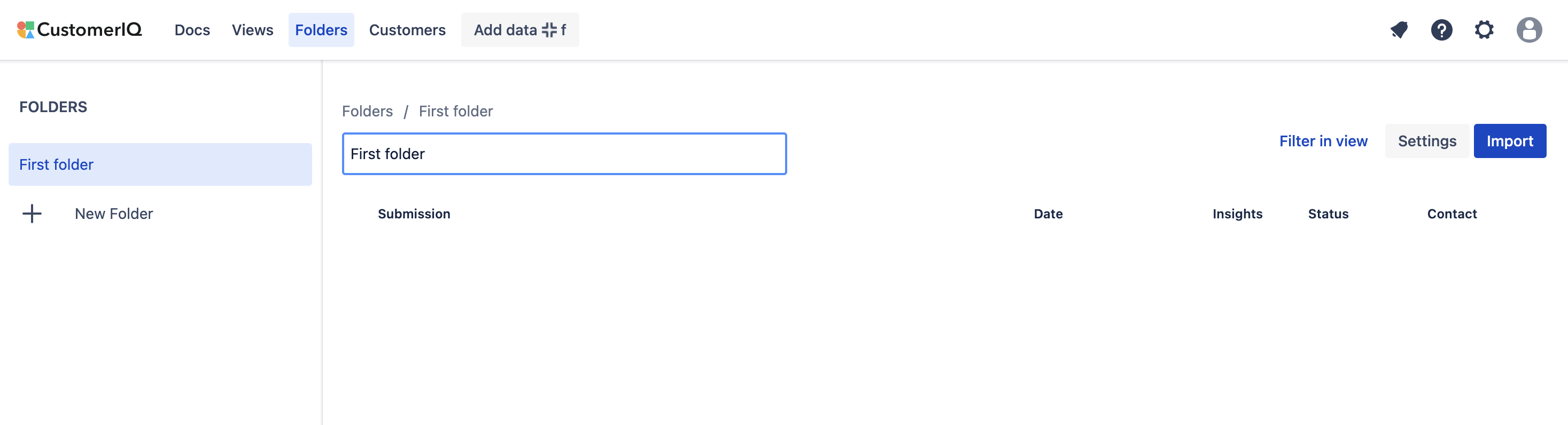
On any folder simply click the name of the folder to change its name.
We provide each workspace with a set of default folders but you can rename or delete these folders any time.
## Use folders to organize submissions by team or type
Think of folders as a way to organize different calls and notes across different teams. For example, your sales teams and customer success teams are both recording meetings with CustomerIQ, you'll want to have each member default their meeting recordings to their respective folders
With Folders, you can have your sales members point their meeting recordings to the Sales Folder and CS managers point their recordings to the CS folder.
Example customer success folder
{% hint style="info" %}
**Pro tip:** It's tempting to use folders to organize calls and emails by things like customer names or deals but this is a lot to manage and not recommended. Instead, CustomerIQ automatically organizes highlights and submissions by associated contacts and accounts. You can always find these from the contacts or accounts pages.
{% endhint %}
### Moving submissions to a different folder
Many times users will record calls or emails that could be better suited in a different folder than their default setting, like sales calls and internal calls.
You can move any submission to any folder by selecting the submission from the index page and clicking "Move to folder"